

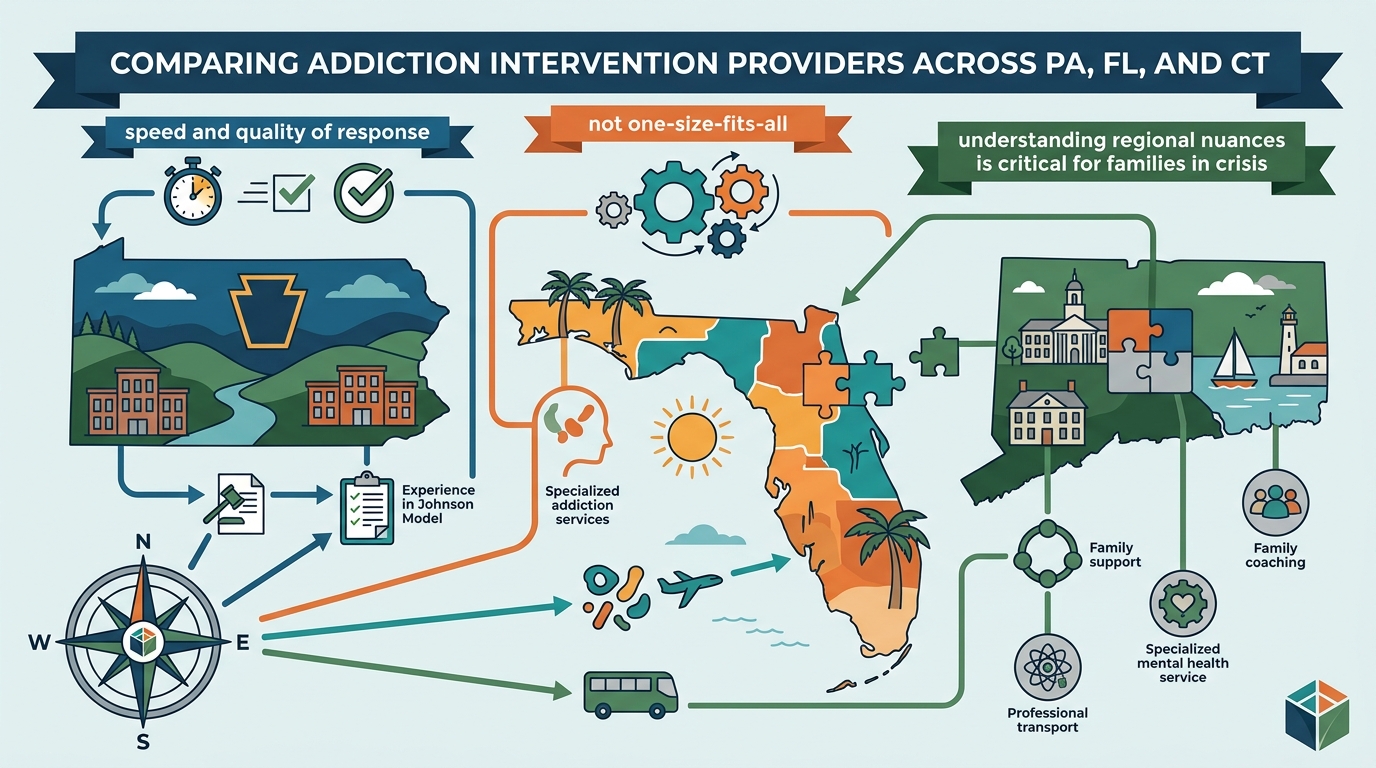
When a family crisis involving substance use disorder strikes, the speed and quality of the response determine the outcome. Professional intervention services are not one-size-fits-all; they vary significantly by region due to differences in local treatment infrastructure, legal frameworks, and the specific prevalence of certain substances. For families in Pennsylvania, Florida, and Connecticut, understanding these regional nuances is critical for securing immediate, effective care. According to the National Institute on Drug Abuse (NIDA), synthetic opioid-involved deaths continue to rise across the United States, highlighting the urgent need for tailored intervention strategies that address local epidemic trends. This guide compares the operational realities of intervention providers in these three key states, focusing on how Intervention 365 and similar elite providers navigate these distinct landscapes. (Florida Family Intervention Services)
Regional Overview: PA, FL, and CT
Intervention 365, led by Certified Intervention Professional Jim Reidy, serves families across the East Coast, including Pennsylvania, Florida, and Connecticut. While the core Johnson Model intervention approach remains consistent, the execution differs based on local resources. An addiction intervention is a structured and professionally guided meeting involving family members, loved ones, and the intended patient. The goal is to interrupt denial and guide the individual toward immediate treatment. However, the availability of detox beds, the cost of care, and the legal mechanisms for involuntary commitment vary by state. (Connecticut Intervention for Addiction)
Families often struggle to find providers who understand these local dynamics. A provider in Florida must navigate a saturated market of treatment centers, while a provider in Pennsylvania must address the specific logistical challenges of rural and urban opioid distribution. In Connecticut, the integration of mental health services is paramount. Understanding these differences helps families choose the right interventionist for their specific geographic and clinical needs.
Pennsylvania: Navigating the Opiate Crisis
Pennsylvania has been heavily impacted by the opioid epidemic, with a high prevalence of fentanyl and heroin use. Intervention providers in PA must be adept at handling cases involving potent synthetic opioids, which require immediate medical detoxification. The state has a robust network of treatment facilities, but access can be fragmented between urban centers like Philadelphia and Pittsburgh and rural areas.
For families in Pennsylvania, the primary challenge is often the speed of placement. Immediate detox placement is critical to prevent overdose. Intervention 365 leverages its extensive network to secure beds quickly. Jim Reidy, who has conducted over 750 interventions, understands the local landscape and can coordinate with PA-based medical professionals to ensure a seamless transition from the intervention site to a detox facility. This local knowledge reduces the time between the intervention and the start of treatment, a crucial factor in survival rates.
Additionally, Pennsylvania’s legal framework regarding involuntary commitment can be complex. Interventionists must work closely with family members to understand their options for securing treatment if the individual refuses voluntary admission. This requires a deep understanding of state-specific laws and the ability to act decisively under pressure.
Florida: The Landscape of Recovery Tourism
Florida is a major hub for addiction treatment, often referred to as a destination for "recovery tourism." This creates a unique environment for intervention providers. On one hand, there is an abundance of treatment options, including luxury rehab centers and specialized programs for various substances. On the other hand, the market is saturated, making it difficult for families to distinguish between high-quality care and less effective facilities.
Intervention providers in Florida must be discerning partners with treatment centers. They need to know which facilities offer evidence-based care and which are merely marketing-driven. Intervention 365’s experience in Florida allows them to match families with the most appropriate level of care, whether it is inpatient residential, outpatient, or specialized mental health treatment. This vetting process ensures that the individual receives care that matches their specific clinical needs, rather than just the first available bed.
Furthermore, Florida’s climate and lifestyle can be triggers for relapse. Effective interventions in FL often include planning for a change of environment post-treatment. Providers must consider the individual’s support system and whether staying in Florida is conducive to their long-term recovery. This strategic planning is a key differentiator for elite interventionists who focus on sustainable outcomes rather than just immediate placement.
Connecticut: Mental Health Integration
Connecticut faces significant challenges with addiction and mental health, with data showing that hundreds of thousands of residents needed but did not receive treatment for substance use disorders in recent years. The state has a strong emphasis on integrating mental health services with addiction treatment, recognizing the high comorbidity between the two.
Intervention providers in CT must be skilled in dual-diagnosis assessments. Many individuals struggling with addiction also suffer from anxiety, depression, or trauma. An effective intervention in Connecticut must address these underlying mental health issues to prevent immediate relapse. Intervention 365’s approach in CT includes thorough assessment and planning that incorporates mental health professionals into the intervention team.
The state also has specific resources for families, including support groups and legal aid. Interventionists in CT leverage these resources to provide comprehensive support. This includes helping families navigate insurance coverage and understanding the state’s Medicaid expansion for addiction services. By integrating these local resources, providers can reduce the financial burden on families and ensure continuity of care.
Comparing Provider Models
When comparing intervention providers across these states, several key factors emerge. The best providers share common traits: extensive experience, a network of trusted treatment partners, and a compassionate, structured approach. However, their regional expertise sets them apart.
| Factor | Pennsylvania Focus | Florida Focus | Connecticut Focus |
|---|---|---|---|
| Primary Substance | Opioids/Fentanyl | Alcohol/Benzodiazepines | Mixed/Polysubstance |
| Key Challenge | Speed of Detox Placement | Navigating Saturated Market | Mental Health Integration |
| Provider Role | Logistics & Medical Coordination | Facility Vetting & Matching | Dual-Diagnosis Assessment |
| Legal Context | Involuntary Commitment Laws | Insurance & Out-of-State Care | Medicaid & State Resources |
Intervention 365 excels in all three regions by combining national expertise with local knowledge. Jim Reidy’s experience allows him to adapt the intervention strategy to the specific needs of each state. Whether it is securing a rapid detox bed in PA, vetting a luxury rehab in FL, or integrating mental health care in CT, the provider’s ability to navigate local systems is vital.
Key Takeaways
- Regional Expertise Matters: Providers must understand local treatment landscapes, legal frameworks, and prevalent substances in PA, FL, and CT.
- Speed is Critical: In opioid-heavy regions like PA, immediate detox placement is the primary goal of the intervention.
- Market Saturation in FL: Florida’s abundance of centers requires rigorous vetting to ensure quality care.
- Mental Health Integration: CT interventions must address dual-diagnosis needs to ensure long-term success.
- Experience Counts: Providers with 15+ years of experience, like Jim Reidy, have the networks and skills to handle complex cases.
- Family Support: Effective interventions include ongoing family coaching and boundary setting, not just the event itself.
- Proven Track Record: Look for interventionists who have conducted hundreds of successful interventions and have verifiable outcomes.
Frequently Asked Questions
What is the difference between an intervention in PA vs. FL?
In Pennsylvania, the focus is often on rapid detox placement due to the opioid crisis. In Florida, the focus is on navigating a saturated market of treatment centers to find the right fit for the individual’s needs.
How does Intervention 365 operate in Connecticut?
Intervention 365 integrates mental health services into its Connecticut interventions, addressing dual-diagnosis needs and leveraging state-specific resources for families.
What is the Johnson Model?
The Johnson Model is a family-centered intervention approach focused on preparation, structure, compassion, accountability, and treatment readiness, rather than confrontation.
Can Intervention 365 help with out-of-state treatment?
Yes, Intervention 365 coordinates treatment placement across state lines, ensuring that individuals receive care in the most appropriate facility regardless of location.
How long does an intervention take?
The intervention process typically involves weeks of preparation, followed by a single-day event. However, the planning phase is critical for success.
What if my loved one refuses treatment?
Interventionists are trained to handle resistance and can utilize legal options or alternative strategies to encourage acceptance of care.
Is insurance coverage available for interventions?
Many insurance plans cover the treatment phase of addiction care. Intervention 365 can assist families in verifying benefits and navigating coverage.
Contact Intervention 365
If you are facing a family crisis in Pennsylvania, Florida, or Connecticut, do not wait for rock bottom. Professional intervention services can provide the structure and support needed to save a life. Jim Reidy and the team at Intervention 365 are ready to assist you with compassion and expertise. Contact us today to discuss your options and begin the path to recovery. Click here to contact Intervention 365 or call (888)-972-8513 for immediate assistance.