

When a loved one is trapped in addiction, families face a painful question: should we try to handle the conversation ourselves or bring in a professional interventionist? The answer lies in the data. Research from the Association of Intervention Specialists and the National Council on Alcoholism and Drug Dependence consistently shows that professionally led interventions achieve an 80% to 90% success rate in getting individuals to agree to treatment. Without that professional structure, families often see the conversation backfire, pushing the person deeper into denial. Below, we break down the numbers, explain why the gap is so large, and show you how to take the next step.
What Is a Professional Intervention?
A professional intervention is a structured, compassionate conversation facilitated by a trained specialist who guides family members and friends through the process of motivating a loved one to accept treatment. A drug interventionist is a certified expert whose primary goal is to help the individual acknowledge the severity of their addiction and agree to enter a recovery program.
Unlike casual family conversations, professional interventions follow proven models such as the Johnson Model. At Intervention 365, every intervention is grounded in a family-first philosophy that addresses not just the person using substances but the entire family system.
The Success Rate Data: Professional vs. DIY
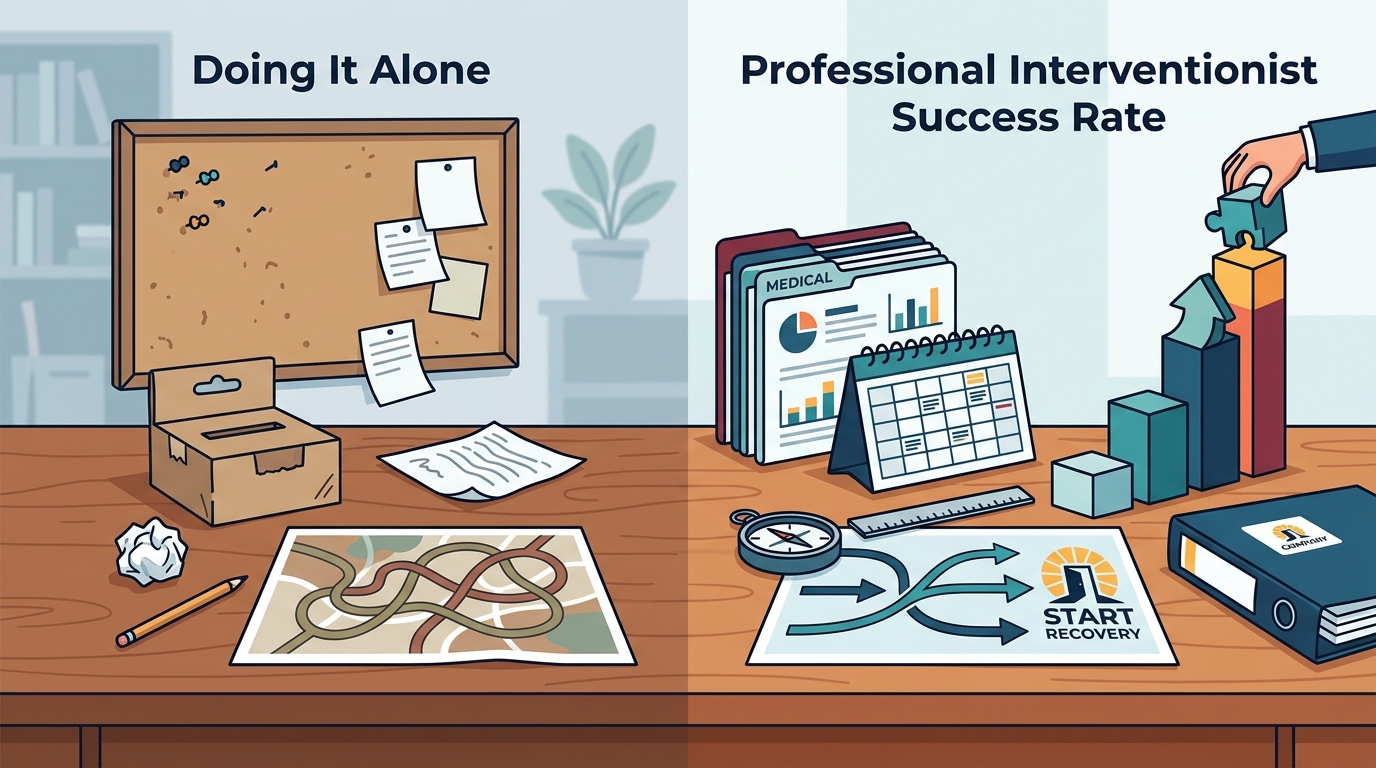
The numbers paint a clear picture. According to the Association of Intervention Specialists (AIS), most interventionists report success rates in the 80% to 90% range, defined as the individual agreeing to enter treatment. The National Council on Alcoholism and Drug Dependence (NCADD) corroborates this, reporting higher than 90% success when a trained professional leads the process.
| Approach | Success Rate (Treatment Entry) | Risk of Negative Outcome |
|---|---|---|
| Professional Interventionist | 80% - 90% | Low: structured, rehearsed, guided |
| Family-Only (DIY) Approach | Significantly lower (no reliable benchmark) | High: emotional escalation, denial reinforcement |
| ARISE Model (graduated professional) | 83% | Low: collaborative, tiered process |
Of the 10% to 20% who do not accept treatment immediately after a professional intervention, roughly half enter treatment within one to two weeks. That means the real reach of a professional intervention extends well beyond the day of the conversation itself.
Why Professional Interventions Work Better
Structure and Planning
A professional interventionist brings a detailed roadmap. At Intervention 365, the process starts with a comprehensive assessment, moves through collaborative family planning, and culminates in the intervention conversation. This level of structured staging removes guesswork and reduces emotional volatility.
Family Education and Boundary Setting
Enabling is a pattern of behavior in which family members unintentionally support the continuation of addiction. A professional helps families identify and correct enabling behaviors, replacing them with healthy boundaries that increase the likelihood of treatment acceptance.
Neutral Mediation
When emotions run high, conversations derail. A certified interventionist serves as a neutral third party who keeps the discussion focused on empathy and solutions rather than blame. Jim Reidy, the board-certified interventionist behind Intervention 365, has completed more than 750 successful interventions across Pennsylvania, Florida, and the broader East Coast.
Risks of Doing It Alone
Families who attempt a DIY intervention often face serious consequences. Without professional guidance, the individual may feel ambushed, attacked, or cornered. The result is frequently the opposite of what the family intended: the person retreats further into addiction, leaves the home, or cuts off communication entirely.
Common pitfalls of unguided interventions include:
- Emotional arguments that escalate into shouting or personal attacks
- Lack of a clear treatment plan, leaving the person with no actionable next step
- Divided family members who send conflicting messages
- No follow-up plan if the person initially refuses
As research underscores, the effectiveness of any intervention depends heavily on preparation and whether the team sought professional help in the planning process. Waiting or improvising can cost precious time in a situation where every day matters.
What to Expect During a Professional Intervention
If you choose to work with Intervention 365, the process typically unfolds in four stages:
- Initial Consultation: The interventionist assesses the situation, gathers history, and begins building a customized plan.
- Family Preparation: Family members receive coaching on what to say, how to set boundaries, and what outcomes to expect.
- The Intervention: A compassionate, non-confrontational conversation takes place, guided by the interventionist, with treatment options already arranged.
- Treatment Placement and Follow-Up: The interventionist helps coordinate transportation to detox or rehab and remains available for ongoing support.
Intervention 365 offers family-friendly pricing so that cost does not become a barrier to getting help. The team serves families across Pennsylvania, Florida, New Jersey, Maryland, Virginia, and Delaware.
Key Takeaways
- Professional interventions achieve an 80% to 90% treatment entry rate according to the AIS and NCADD.
- DIY interventions carry a high risk of emotional escalation, denial reinforcement, and relationship damage.
- About half of individuals who initially decline treatment after a professional intervention enter treatment within two weeks.
- The ARISE model, a graduated professional approach, shows an 83% success rate backed by NIH research.
- Enabling behaviors are a key obstacle; professional guidance helps families recognize and stop them.
- Early intervention leads to better long-term recovery outcomes.
- Intervention 365 has completed over 750 successful interventions led by board-certified professionals.
Frequently Asked Questions
What is the success rate of a professional intervention?
Most professional interventionists report an 80% to 90% success rate, meaning the individual agrees to enter treatment. The NCADD places the figure above 90% when a trained professional is involved.
What happens if the person refuses treatment after an intervention?
Roughly half of individuals who refuse immediately after a professional intervention agree to enter treatment within one to two weeks. The process still benefits the family by establishing boundaries and reducing enabling.
Can a family successfully intervene without a professional?
While it is possible, the odds drop significantly. Unstructured conversations often escalate emotionally, causing the person to shut down, leave, or become more resistant to future help.
How much does a professional intervention cost?
Costs vary by provider and complexity. Intervention 365 offers family-friendly pricing designed to keep professional help accessible. Contact the team directly for a personalized quote.
What is the Johnson Model of intervention?
The Johnson Model is a widely used intervention framework that involves a loving, non-confrontational approach where family members unite under professional guidance to motivate a loved one to accept treatment. It is the primary model used by Intervention 365.
How long does the intervention process take?
From initial consultation to the intervention itself, the timeline typically spans a few days to a week. In urgent situations, Intervention 365 has mobilized within 24 hours.
Does Intervention 365 serve areas outside Pennsylvania?
Yes. Intervention 365 operates across Pennsylvania, Florida, New Jersey, Maryland, Virginia, Delaware, and beyond. The team travels nationwide when needed.
Is there scientific evidence that interventions work?
Yes. A 2009 Stage 1 NIH study found the ARISE intervention model achieved an 83% success rate. Broader industry data from the AIS and NCADD consistently supports the 80% to 90% range for professionally led interventions.
Take Action Today
Every day without action is another day addiction tightens its grip. If someone you love is struggling, do not wait for rock bottom. Contact Intervention 365 now to speak with a board-certified interventionist who can help your family create a plan and move toward healing. Call today and take the first step toward reclaiming your family's future.