

Professional Interventionist Success Rate vs. Doing It Alone: A Data-Driven Comparison
When a loved one is trapped in addiction, families face a critical decision: attempt an intervention on their own or bring in a certified professional. The difference in outcomes is dramatic. This comparison breaks down the real numbers, explains why expert guidance matters, and helps you decide the right path for your family.
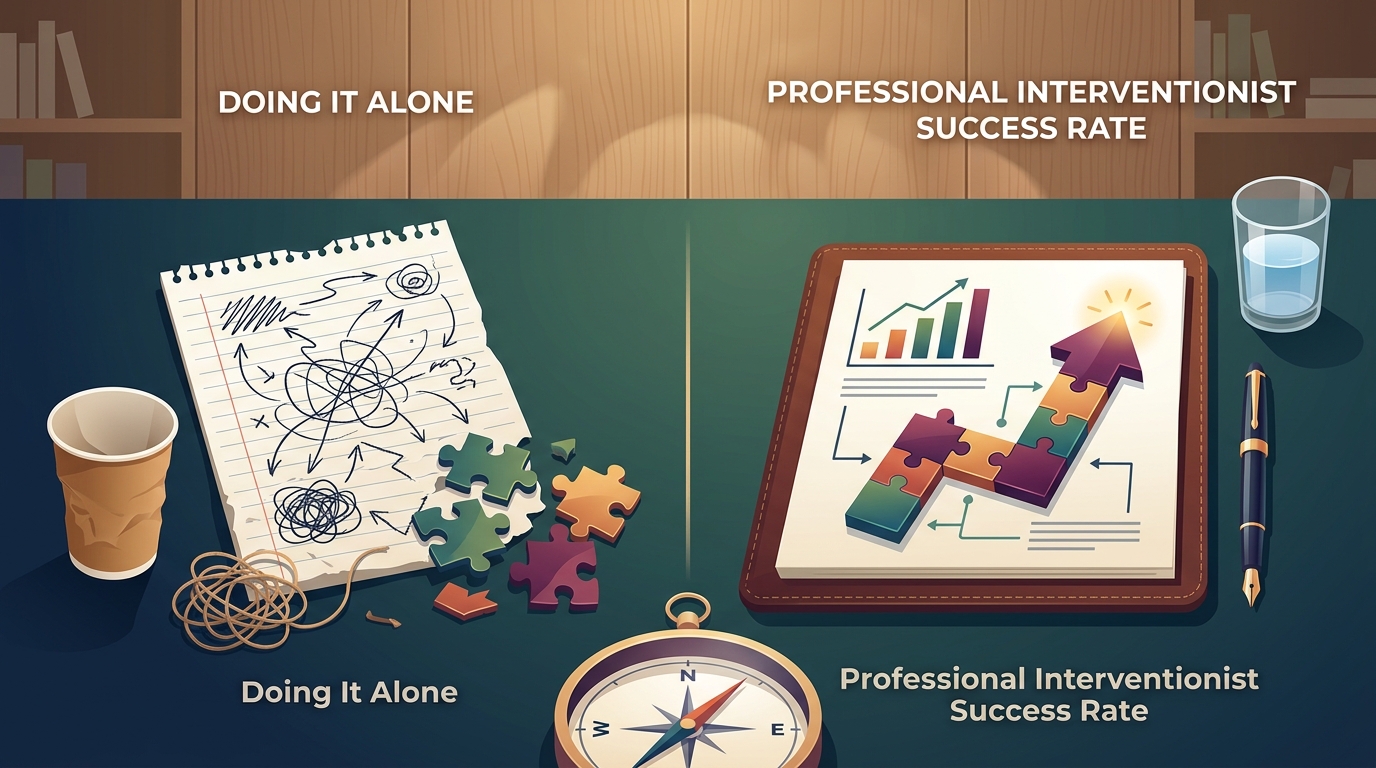
The Numbers: Professional Interventions Achieve 80–90% Success
The most widely cited figures in the intervention field come from the Association of Intervention Specialists (AIS). According to AIS data, professionally guided interventions result in the individual agreeing to enter treatment 80–90% of the time. Furthermore, of the 15–20% who decline on intervention day, about half choose to seek treatment within a week or two.
The National Council on Alcoholism and Drug Dependence (NCADD) places the figure even higher, reporting that interventions involving a professional boast a success rate of over 90% in getting the individual to agree to seek treatment. Some individual practitioners report lifetime success rates as high as 96%.
Family-Led Interventions: Well-Intentioned but Often Insufficient
Families who attempt an intervention without professional support face significantly lower odds. A landmark 1999 study compared three approaches among concerned significant others: Johnson Model interventions, Al-Anon facilitation, and Community Reinforcement and Family Training (CRAFT). The CRAFT method achieved 64% treatment entry, Johnson interventions reached about 30%, and Al-Anon facilitation resulted in only 13%.
These numbers reveal an important nuance: even structured family approaches like the Johnson Model—without a trained facilitator—see roughly one-third of loved ones agree to treatment. Family-led interventions without professional support often have modest results, frequently hindered by emotional confrontations and lack of clear treatment pathways.
Side-by-Side Comparison
| Factor | Professional Interventionist | Family-Led (No Professional) |
|---|---|---|
| Treatment acceptance rate | 80–90%+ | 13–30% (varies by method) |
| Structured planning | Multiple coached sessions | Often minimal or ad hoc |
| Emotional management | Trained facilitator present | High risk of confrontation |
| Treatment placement | Pre-arranged and coordinated | Family must research alone |
| Post-intervention support | Ongoing family coaching | Typically none |
| Risk of relationship damage | Minimised through rehearsal | Significant |
Why the Gap Is So Large: 5 Factors That Drive Professional Success
1. Objective Facilitation Prevents Escalation
Addiction breeds chaos within families. Years of broken promises and enabling behavior make it nearly impossible for family members to stay calm and non-confrontational during an emotionally charged conversation. A professional interventionist serves as a neutral third party who keeps the discussion focused, productive, and free from blame or anger.
2. Evidence-Based Models Are Applied Correctly
Professional interventionists are trained in specific models—the Johnson Model, Love First, ARISE, CRAFT-informed approaches, and the Systemic Family Model. Each model has particular protocols. For example, the Love First approach involves writing structured letters with three components: shared history, expressions of affection, and a commitment to support recovery. Without training, families often skip critical steps or abandon the model entirely under pressure.
3. Treatment Placement Is Pre-Arranged
One of the biggest reasons DIY interventions fail is the gap between agreement and admission. When a loved one says yes, there is a narrow window of willingness. Professional interventionists have treatment beds secured, insurance verified, and travel arranged before intervention day. This eliminates delays that allow the person to change their mind.
4. The Family System Gets Help Too
A quality intervention is not just about the person with the substance use disorder. Family recovery and follow-through increase successful outcomes long-term for everyone involved. Professional interventionists coach family members on setting boundaries, ending enabling behaviors, and beginning their own recovery—regardless of whether the loved one accepts treatment.
5. Contingency Planning for Every Scenario
What happens if the person storms out? Becomes verbally aggressive? Agrees to treatment but only on conditions? Professional interventionists prepare the team for every possible reaction during rehearsal sessions. This preparation is virtually impossible to replicate without professional guidance.
Risks of Going It Alone
Poorly planned interventions carry real dangers that go beyond simply failing to convince a loved one to enter treatment:
- Relationship damage: The person may feel ambushed, attacked, or betrayed, potentially severing ties with the family and retreating further into substance use.
- Escalation of use: A botched intervention can trigger increased substance use out of anger, shame, or defiance.
- Missed timing: Approaching someone while they are intoxicated, in withdrawal, or in an emotionally volatile state can make the situation far worse.
- No follow-through plan: Without consequences established and enforced, the intervention becomes an empty conversation that the person learns to dismiss.
Understanding What “Success” Really Means
Success rates can be misleading if you do not understand how success is defined. Most interventionists define initial success as the individual agreeing to enter a treatment program. However, entering treatment and completing treatment are two different milestones, and completing treatment and maintaining long-term sobriety are yet another.
A broader definition includes the transformation of the family system. By this measure, even when the individual declines treatment, the intervention is still valuable because the family learns to stop enabling, establishes healthy boundaries, and begins its own recovery.
What a Professional Interventionist Actually Does
- Assessment call: Gathers detailed history about the individual, substances involved, co-occurring mental health conditions, family dynamics, and previous treatment attempts.
- Family coaching sessions: Educates family members on addiction as a disease, trains them in communication techniques, and helps each person prepare their statement or letter.
- Logistics coordination: Identifies appropriate treatment facilities, verifies insurance coverage, arranges travel, and packs bags if needed.
- Rehearsal: Conducts a full run-through of the intervention with the team to anticipate reactions and refine messaging.
- Intervention day: Facilitates the conversation, manages emotional dynamics, presents treatment options, and transports the individual to the facility if they agree.
- Follow-up: Checks in with both the individual in treatment and the family to ensure compliance with the aftercare plan.
How to Choose the Right Interventionist
Not all interventionists are equal. When evaluating professionals, look for these credentials and qualities:
- Certification: Look for credentials such as Certified Intervention Professional (CIP) or Board Registered Interventionist (BRI).
- Experience: Ask about the number of interventions conducted and their specific success rate.
- Model expertise: Ensure they use evidence-based models and can explain their approach clearly.
- Treatment independence: Choose an interventionist who recommends treatment centers based on clinical fit, not financial kickbacks.
- Family support: The best interventionists provide ongoing coaching for the family, not just a one-day event.
- Availability: Addiction crises do not follow business hours. Look for 24/7 availability.
Key Takeaways
- Professional interventions achieve an 80–90% success rate in getting a loved one to agree to treatment, with some practitioners reporting rates above 90%.
- Family-led interventions without professional guidance see significantly lower success—research shows rates between 13% and 30% depending on the method used.
- The CRAFT model, which emphasises positive reinforcement over confrontation, achieves roughly 64% treatment entry—still lower than a professionally facilitated intervention but far better than traditional DIY methods.
- Success is not just about treatment entry. A well-conducted professional intervention transforms the entire family system and lays the groundwork for sustained recovery.
- Poorly executed interventions risk pushing the individual further away and damaging family relationships.
- When selecting an interventionist, prioritise certification, independence from treatment centres, and a commitment to family recovery.
Frequently Asked Questions
What is the success rate of a professional intervention?
According to the Association of Intervention Specialists, most interventionists report success rates in the 80–90% range, defined as the individual agreeing to enter treatment. The NCADD reports that with a skilled interventionist, success rates exceed 90%.
What happens if the person refuses treatment after an intervention?
Of the 15–20% who do not agree to treatment on intervention day, approximately half choose to seek help within one to two weeks. The family still benefits by gaining new tools, establishing boundaries, and ending enabling behaviors.
What is the success rate of an intervention without a professional?
Research shows that traditional family-led methods like the Johnson Model achieve about 30% treatment entry, while Al-Anon facilitation reaches roughly 13%. The CRAFT approach, which can be learned by family members, achieves about 64%.
What does a professional interventionist actually do?
A professional interventionist conducts a full assessment, coaches the family through multiple sessions, arranges treatment placement and logistics, facilitates the intervention conversation, and provides follow-up support for the family and the individual in treatment.
Is hiring a professional interventionist worth the cost?
Given the dramatic difference in success rates—80–90% with a professional versus 13–30% without—the investment typically proves worthwhile. The cost of continued addiction in terms of medical bills, legal issues, lost employment, and family breakdown almost always exceeds the cost of professional intervention services.
Can I use the CRAFT method on my own?
CRAFT can be learned through books, online courses, and therapist-guided sessions. It achieves roughly 64% treatment entry, making it the most effective approach families can use independently. However, combining CRAFT principles with a professional interventionist further increases the likelihood of success.
If your family is facing a crisis and you need expert guidance, contact Intervention 365 for a confidential consultation. Professional help is available around the clock.