

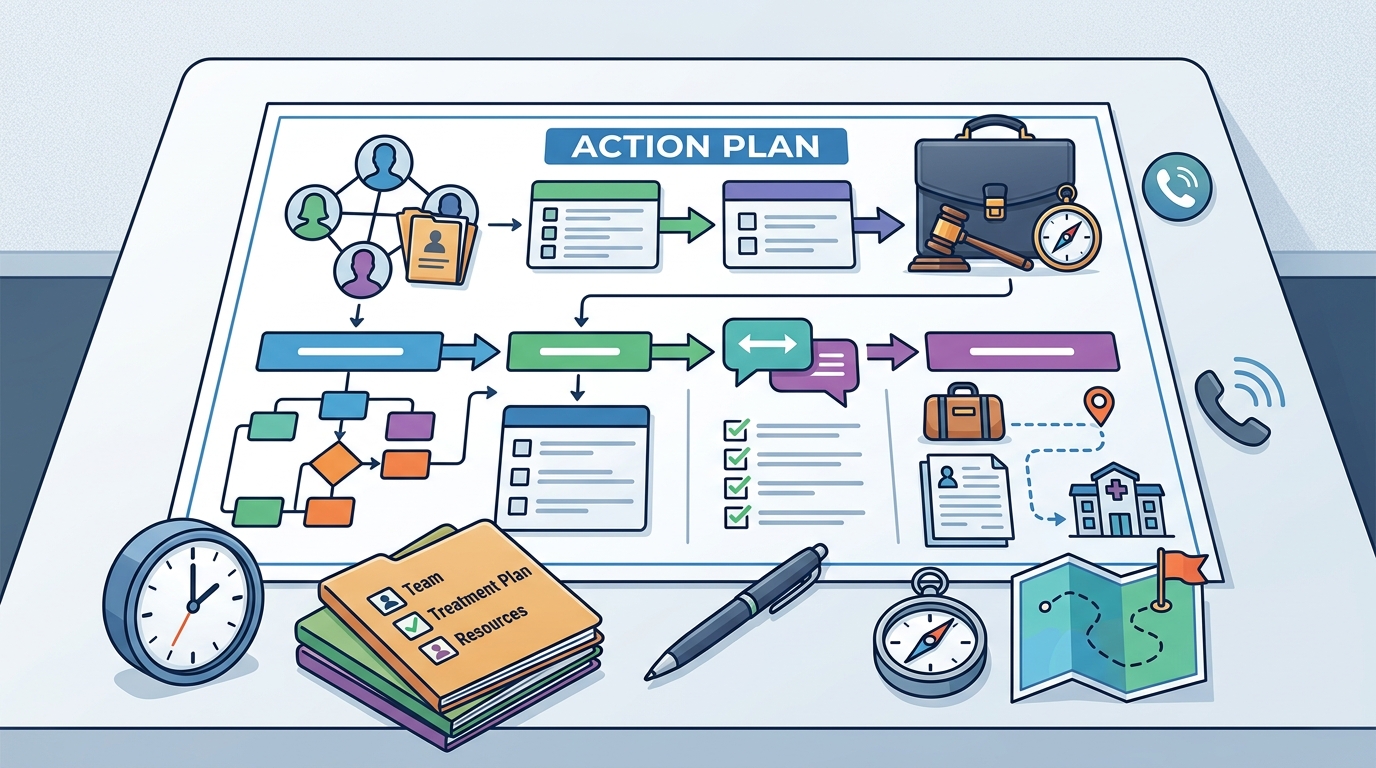
When someone you love is spiraling deeper into substance abuse and every day feels like a gamble with their life, waiting is no longer an option. An emergency addiction intervention can be the turning point that redirects your loved one toward recovery—but only if it is carefully prepared. This action plan walks you through every critical step so you can move quickly, compassionately, and effectively. For immediate professional guidance, call Intervention365.com.
Step 1: Recognize When the Situation Is Urgent
Not every addiction scenario calls for an emergency intervention, but certain warning signs demand immediate action. If your loved one has experienced a recent overdose, expressed suicidal thoughts, lost a job, been arrested, or is physically deteriorating, the window for waiting has closed.
According to the Mayo Clinic, people who struggle with addiction often refuse to acknowledge the problem and resist treatment. When a direct conversation has already failed, a structured group intervention becomes the logical next step.
Step 2: Contact a Professional Interventionist Immediately
The single most important preparation step is engaging a professional. A qualified interventionist serves as a neutral facilitator who guides every aspect of the process—from planning through execution—and dramatically increases the likelihood of a positive outcome.
Professional interventionists help families break through denial, manage volatile reactions, and ensure the conversation stays productive. If unpredictable or violent behavior is a concern, a professional becomes even more critical for everyone's safety.
At Intervention365.com, our specialists are available around the clock to begin the planning process with your family. A single phone call can set the entire preparation in motion within hours.
How to Find the Right Interventionist
- Ask your family doctor or therapist for a referral.
- Search the Association of Intervention Specialists directory.
- Ask about their specific intervention model (Johnson Model, ARISE, Invitational, etc.).
- Inquire how they prepare families and handle resistance.
- Verify credentials, insurance compatibility, and references.
Step 3: Build Your Intervention Team
The intervention team should consist of four to six people who are close to your loved one and whose opinions they respect. This typically includes family members, close friends, and sometimes an employer or faith leader.
Who Should Be on the Team
- Immediate family: spouse, parents, siblings, adult children
- Trusted friends who have witnessed the addiction's impact first-hand
- An employer, coach, or mentor—someone the person looks up to
- A faith leader, if spirituality is important to your loved one
Who Should NOT Participate
- Anyone who is currently struggling with their own active addiction
- People who are likely to become angry, confrontational, or blame the individual
- Very young children who may be traumatized by intense emotions
- Anyone the person has a deeply contentious relationship with
Step 4: Educate Yourself on Addiction
Before you sit across from your loved one, you need to understand the disease you are confronting. Addiction changes brain chemistry in ways that cause users to prioritize substance use above everything else, including relationships and personal safety.
Every participant in the intervention should receive education about the science of addiction, common defense mechanisms like denial and minimization, and realistic expectations for recovery timelines. Your interventionist will typically lead this educational session, but independent reading and resources from organizations like SAMHSA and the National Institute on Drug Abuse can deepen your understanding.
Step 5: Research and Pre-Arrange Treatment Admission
One of the most overlooked—and most critical—steps is having a treatment plan fully arranged before the intervention takes place. If your loved one says yes, you need to act within hours, not days. Motivation is fleeting, and delays allow denial to return.
Your Treatment Research Checklist
- Identify the right level of care: Determine whether your loved one needs medical detox, inpatient residential treatment, a partial hospitalization program, or intensive outpatient care.
- Verify insurance coverage: Contact your insurance provider and prospective treatment centers to confirm benefits and out-of-pocket costs.
- Pre-arrange admission: Complete intake paperwork, schedule an evaluation appointment, and confirm a bed or slot is reserved for the target date.
- Arrange transportation: Have bags packed and a plan to drive or fly to the facility immediately after the intervention.
- Prepare multiple options: Your loved one may reject the first suggestion. Having two or three vetted alternatives shows flexibility while keeping momentum.
Intervention365.com can connect your family with vetted treatment programs nationwide, helping you match the right facility to your loved one's clinical needs, location preferences, and financial situation.
Step 6: Write Personal Impact Statements
Impact statements are the emotional core of any intervention. Each participant writes a personal letter that describes specific ways the addiction has harmed them and their relationship with the person.
How to Structure an Effective Impact Statement
- Open with love: Begin by affirming your relationship and care. Example: "You are my brother, and I love you more than I can put into words."
- Share specific incidents: Describe real moments when the addiction caused pain. Concrete stories are far more powerful than generalizations.
- Use "I" language: Instead of "You ruined Thanksgiving," say "I felt heartbroken when you didn't show up for Thanksgiving dinner."
- Connect to feelings: Name the emotions—fear, sadness, worry, embarrassment—so your loved one understands the personal cost.
- Close with hope and a request: End by expressing your belief that recovery is possible and asking them to accept the help being offered.
Keep statements concise—roughly one to two pages—and practice reading them aloud multiple times. Your interventionist should review every letter before the meeting to ensure the tone remains compassionate, not accusatory.
Step 7: Establish Clear Boundaries and Consequences
Before the intervention, each team member must decide what specific actions they will take if the person refuses treatment. These are not threats or punishments; they are self-protective boundaries designed to stop enabling behavior.
Examples of Boundaries
- Discontinuing financial support (rent payments, car insurance, phone bills)
- Restricting access to grandchildren or younger family members
- Refusing to bail the person out of legal trouble
- No longer covering up or making excuses for missed obligations
- Asking the person to leave the family home until they seek help
Every consequence you name must be one you are genuinely prepared to enforce. Stating a boundary and then failing to follow through undermines the entire intervention and reinforces the addictive cycle.
Step 8: Plan the Logistics — Time, Place, and Flow
The practical details matter more than most families realize. Poor timing or a poorly chosen location can derail even the most heartfelt intervention.
Choosing the Right Time
Schedule the intervention for a time when your loved one is most likely to be sober. Early morning often works well. Avoid holidays, birthdays, or days following stressful events.
Choosing the Right Location
Select a private, neutral setting where everyone can sit comfortably—an interventionist's office, a family meeting room, or a trusted friend's home. Some experts recommend avoiding the person's own home, as it can trigger defensiveness.
Planning the Flow
- Designate a lead speaker (often the interventionist) to open and close.
- Decide a specific speaking order for impact statements.
- Plan a clear transition from statements to the treatment offer.
- Agree on a safe word that signals a brief pause if emotions escalate.
- Aim for 60 to 90 minutes total. Longer sessions tend to increase anger and reduce compassion.
Step 9: Rehearse the Entire Intervention
A full dress rehearsal is non-negotiable. Gather the team—without the person who will be the subject—and run through the entire meeting from start to finish.
What Rehearsal Accomplishes
- Reveals statements that may sound blaming or triggering so they can be revised.
- Helps participants manage their own emotions before the high-pressure moment.
- Ensures everyone knows exactly when they speak and what comes next.
- Allows the interventionist to coach tone, body language, and pacing.
- Builds team unity and confidence.
Role-play potential reactions—anger, tears, deflection, walking out—so the team knows how to respond calmly rather than reactively.
Step 10: Execute the Intervention Day
On intervention day, the team gathers at the location before the loved one arrives. Getting the person there typically involves a simple, non-alarming invitation such as a family brunch or casual get-together.
During the Meeting
- The lead speaker opens with a warm, direct statement explaining why everyone is present.
- Each participant reads their impact statement in the predetermined order.
- The treatment plan is presented with specifics: the facility name, the admission date, what to pack, and who will accompany them.
- The person is asked for an immediate decision—do not offer time to "think it over," as delays allow denial to reassert itself.
- If they agree, move them toward the treatment facility as soon as possible—ideally the same day.
If They Refuse
If your loved one declines treatment, each team member calmly states their predetermined boundary. Do not argue, negotiate, or plead. The interventionist can help de-escalate the situation. Remember: the seed has been planted, and many people accept help in the days following an intervention even when they initially refuse.
Step 11: What Happens After the Intervention
The work does not end when the meeting is over, regardless of the outcome.
If Your Loved One Accepts Treatment
- Transport them to the facility immediately.
- Communicate supportive messages: "We will be with you every step of the way."
- Begin your own recovery work—attend Al-Anon, seek individual counseling, and participate in any family programming offered by the treatment center.
- Plan for aftercare: sober living, outpatient follow-up, and ongoing family therapy.
If Your Loved One Refuses
- Follow through on every stated boundary—no exceptions.
- Continue attending support groups for families of people with addiction.
- Keep communication open with caring, brief invitations: "The offer still stands. We can go any day."
- Consult your interventionist about next steps and timing for a possible follow-up conversation.
The family's own healing matters enormously. Education about enabling, codependency, and healthy boundaries transforms the entire family system—even if the person with addiction is not yet in treatment.
Common Mistakes That Derail an Intervention
| Mistake | Why It Hurts | What to Do Instead |
|---|---|---|
| Going in without a professional | Emotions spiral, the person shuts down or leaves | Hire an interventionist—call Intervention365.com |
| Confronting while the person is intoxicated | They cannot process information or make rational decisions | Schedule for a time they are most likely sober |
| Using accusatory language | Triggers defensiveness and shame | Use "I" statements grounded in specific experiences |
| Not having a treatment plan ready | Momentum is lost; the person changes their mind | Pre-arrange admission and pack a bag in advance |
| Making empty threats | Undermines credibility and enables the cycle | Only state consequences you will genuinely enforce |
| Inviting too many people | Feels like an ambush; overwhelms the individual | Limit the team to 4–6 trusted, composed participants |
Key Takeaways
- Speed matters, but so does structure. An emergency intervention should happen quickly, but never without deliberate planning and professional support.
- A professional interventionist is your most valuable asset. They guide the team, manage crises, and dramatically improve success rates.
- Pre-arrange treatment admission. If your loved one says yes, you must be able to act within hours.
- Lead with love, not anger. Compassion-driven impact statements are the emotional engine of an effective intervention.
- Set real boundaries—and keep them. Consequences must be enforceable and consistently upheld.
- Rehearse everything. Practice reduces emotional volatility and keeps the meeting on track.
- The family needs recovery too. Regardless of outcome, pursue Al-Anon, counseling, and education about enabling.
- Call Intervention365.com for 24/7 professional guidance tailored to your family's unique situation.
Frequently Asked Questions
How quickly can an emergency intervention be organized?
With professional help from a service like Intervention365.com, a crisis intervention can be organized in as little as 24 to 72 hours. The interventionist coordinates team formation, statement preparation, treatment logistics, and rehearsal on an accelerated timeline.
Do interventions actually work?
When properly structured with professional facilitation, interventions can be highly effective. Even when the individual initially refuses treatment, the process educates the family, ends enabling patterns, and plants a seed for future recovery.
What is the ideal number of people at an intervention?
Most experts recommend four to six participants—enough voices to convey broad concern without overwhelming the individual. Each person should be someone the loved one respects and whose opinion carries emotional weight.
Should children be included in an intervention?
Adult children who can manage intense emotions may participate and often deliver the most powerful statements. However, young children should generally not attend, as the experience can be traumatic and unpredictable.
What happens if my loved one walks out during the intervention?
Do not chase or escalate. The interventionist will advise the team on how to respond. In many cases, the person returns within hours or days willing to talk. In the meantime, enforce your stated boundaries consistently.
How much does a professional interventionist cost?
Fees vary widely depending on the model, location, and level of service—ranging from a few hundred dollars for basic phone coaching to several thousand for full-service travel interventions. Some interventionists offer sliding-scale fees, and certain services are covered by insurance. Call Intervention365.com to discuss options that fit your budget.
What should I NOT say during an intervention?
Avoid labels like "addict" or "junkie," ultimatums you will not follow through on, phrases like "why can't you just stop," and any language that places blame. Stick to rehearsed, compassion-centered impact statements.
Can I hold an intervention without a professional?
While it is technically possible, experts strongly advise against it. Without professional facilitation, emotions can overwhelm the meeting, the person may shut down or become hostile, and the opportunity may be lost.